
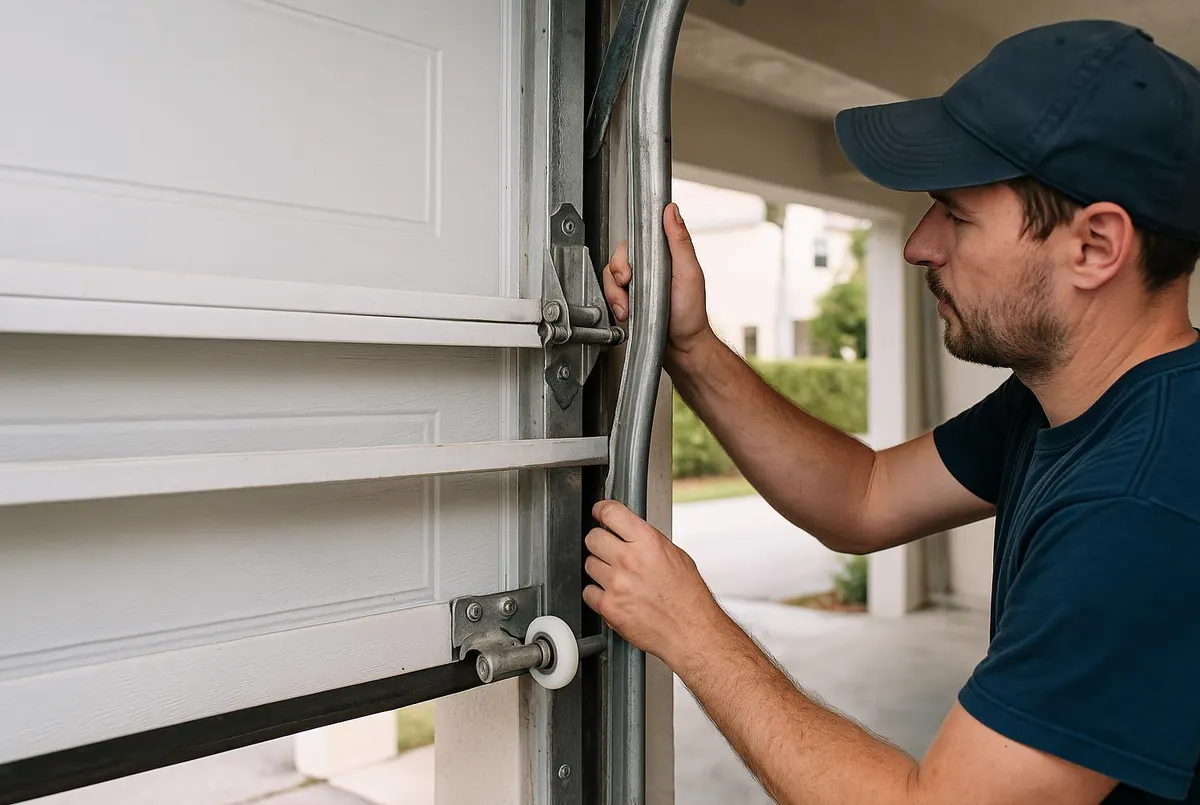
You Hear It Before You See It
You press the opener button, grab your coat, and wait for the door to clear your bumper — except today it doesn't sound right. Maybe it's a metallic grind that makes you wince, a high squeal that carries down the block, a sharp pop like a knuckle cracking, or a loose rattle that shakes the whole frame. Whatever it is, you stop halfway out of the car and think: that's new.
Garage doors don't go from silent to noisy overnight without a reason. Each sound points to a specific part of the system, and most of them get worse — and more expensive — the longer they're ignored, especially once Milwaukee's freeze-thaw cycles start working on worn hardware.
Grinding: Something Is Fighting the Track
Grinding usually sounds like metal scraping metal, often worse at one spot in the door's travel rather than the whole way up or down. It's not subtle — you'll feel it as much as hear it if you're standing nearby.
What a technician checks, in order
- Rollers first. Steel rollers wear down and develop flat spots; nylon rollers crack or lose their stem bearings. A worn roller grinds every time it rotates past the damaged section. Fix: swap the full set of rollers, which also extends the life of the track they ride in.
- Track alignment next. A bent or out-of-plumb track forces rollers to grind against the rail edge instead of rolling freely. This happens often after a car bumps the track or after years of a house settling. Fix: realign or replace the affected track section.
- Opener gear last. On chain and belt-drive openers, a stripped or worn drive gear inside the motor housing grinds under load. Fix: gear replacement, or in older units, a full opener swap if the housing is cracked too.
Squealing: Something Needs Lubrication or Is Past Lubricating
Squealing is a higher-pitched, more continuous sound, usually loudest right as the door starts moving. It's the garage door equivalent of a dry hinge, and it's the noise most likely to show up for the first time after a Wisconsin winter, once road salt and cold have dried out factory grease.
What a technician checks, in order
- Hinges and rollers. Dry pivot points squeal under tension. Fix: a proper garage-door-rated lithium or silicone spray lubricant on hinges, rollers, and the track — not WD-40, which washes grease away rather than replacing it.
- Spring bearing plates. The torsion spring rotates against metal bearing plates at each end; dry bearings squeal sharply with every rotation. Fix: lubricate the bearing plates, or replace them if they've worn grooves.
- Opener chain or belt tension. A chain that's too loose can slap and squeal against the rail. Fix: adjust tension per the opener's manual — too tight is as bad as too loose.
Popping: Something Is Under Sudden Tension or Release
Popping is sharp and isolated — one loud crack rather than a running sound. Homeowners often notice it most in the coldest weeks of winter, when steel panels and hardware contract and flex differently than they do in summer heat.
What a technician checks, in order
- Torsion spring tension. A spring that's slightly unwound or improperly tensioned can pop as it catches and releases. This is also a warning sign of a spring nearing failure. Fix: tension adjustment by a trained technician — this is not a DIY step, since torsion springs store enough force to cause serious injury.
- Loose track joints. Track sections bolt together, and a joint that's worked loose will pop as the door passes over it. Fix: re-tighten or re-align the joint.
- Loose hinges or panel hardware. Popping can also come from a hinge screw backing out, letting a panel flex slightly before the hinge catches. Fix: re-torque or replace the hinge hardware.
- Cold-weather material flex. In deep cold, steel panels and seals contract and can pop softly as the door first moves after sitting overnight. This is usually harmless, but it's worth a check if the popping is new and sharp rather than a familiar, mild sound.
Rattling: Something Is Loose, Not Broken (Yet)
Rattling is a looser, shakier sound — more vibration than friction — and it often gets worse with wind or when a heavy vehicle passes the house.
What a technician checks, in order
- Fasteners along the track and hinges. Vibration from daily use backs out nuts and bolts over time. Fix: a full torque-check of all visible hardware, which is also standard on a maintenance visit.
- Opener chain or belt slack. A chain with too much play rattles against the rail with every start and stop. Fix: tension adjustment.
- Loose or brittle weatherstripping and seals. Seals that have hardened in the cold can flap and rattle in wind. Fix: replacement with a seal rated for cold climates.
- Opener mounting bracket. If the bracket anchoring the opener to the ceiling has loosened, the whole unit can shake. Fix: re-secure to solid framing, not just drywall.
When to Call Milwaukee Garage Door Pro
If you've traced the sound to a worn roller or a dry hinge, a spray lubricant and a tightened bolt might solve it. But grinding that keeps returning, popping that's gotten louder, or any noise connected to a torsion spring is where we step in. Our Garage Door Maintenance visits catch loose hardware and dry bearings before they turn into a 6 a.m. breakdown, and our Spring Repair & Replacement service handles the high-tension components safely, with the right tools and training.
If your garage door in Milwaukee, Wauwatosa, West Allis, Brookfield, Menomonee Falls, Brown Deer, Glendale, or Shorewood is making a noise you don't recognize, don't wait for winter to make it worse. Call Milwaukee Garage Door Pro and we'll get a technician out to track down the real cause and fix it right.